
How to Read an LED Street Light Tender Specification: 11 Checkpoints Buyers Must Verify
How to Read an LED Street Light Tender Specification: 11 Checkpoints Buyers Must Verify
Introduction
In international municipal engineering, highway lighting, and commercial outdoor upgrading projects, a rigorous street light tender specification often makes or breaks the deal. For B2B buyers, municipal procurement officers, and global distributors, breaking down a technical tender document containing dozens or even hundreds of clauses can feel overwhelming. Knowing how to avoid hidden pitfalls is the key to securing cost-effective and fully compliant products when preparing a comprehensive Street Light Tender specification. This guide systematically decodes the core elements of a professional road lighting tender based on standard specifications. We will walk you through the twelve mandatory technical checkpoints and provide a complete parameter matrix to help you gain a competitive edge in fierce bidding and procurement.
What is an LED Street Light Tender Specification, and Why Must You Review It Strictly?
In international B2B lighting projects, municipal general contractors, engineering firms, and local brand operators issue tender documents packed with rigorous hardware and software demands. Failing to review these requirements line by line often leads to costly mistakes during compliance audits, project handovers, optical evaluations, or after-sales warranties. A qualified tender usually covers everything from product coding rules and mechanical structures to optical systems, electrical safety, smart controls, and international certifications.
Core Breakdown: The 11 Mandatory Checkpoints for Road Lighting Tenders
To ensure you stay ahead when reviewing tenders or shaping product solutions, here are the eleven critical checkpoints you need to verify:
Core Component Standards and Quality Assurance
When preparing a competitive LED street light tender specification, tender issuers typically specify tier-one brands for LED drivers and chips such as Philips, OSRAM, Mean Well, and Inventronics for drivers alongside Cree, Lumileds, and Nichia for chips while requiring detailed datasheets. Because drivers and chips dictate the lifespan and stability of the entire fixture, you must ensure your supplier not only uses specified brands but can also provide official supply chain authorization proofs and batch testing reports.
This prevents premature failures or frequent maintenance caused by cheap and generic components. For project implementations requiring robust mechanical and modular designs, utilizing high-performance fixtures such as the Series Lumio Modern Street Light or the Series ALCA Cobra Head Street Light ensures full compliance with mechanical and thermal requirements.
Housing, Surface Treatment, and Branding Craftsmanship

Fixtures must use high-pressure die-cast aluminum with a strict copper content limit kept under 3 percent to guarantee chemical corrosion resistance in coastal high-salt-mist or heavy industrial environments. Tenders usually require third-party laboratory spectral analysis reports for aluminum alloys alongside salt spray test reports. In actual bidding, supplier logo techniques fall into three tiers ranging from ordinary peelable stickers and laser engraving or pad printing to embossed or cast-in-relief molds. For high-end municipal tenders, relief casting represents the highest standard of custom tooling and anti-counterfeiting, though it often comes with minimum order quantities and additional tooling fees that every participant in a street light tender must evaluate carefully..
IP and IK Mechanical Protection Ratings

The complete luminaire alongside independent optical and electrical chambers must achieve a minimum of IP66 to completely block heavy rain, dust, moisture, and small insects. At the same time, the housing impact rating must reach IK10 to withstand harsh external impacts or vibrations. When auditing tender files and test reports during a municipal street lighting tender, verify whether the laboratory report covers the complete assembled luminaire structure. Some suppliers only provide IP certificates for individual LED modules or drivers, which cannot validate the whole fixture. As a direct manufacturer, we provide complete third-party certified IP66 and IK10 reports for entire fixtures to guarantee a smooth project handover.
Optical Distributions and Lenses
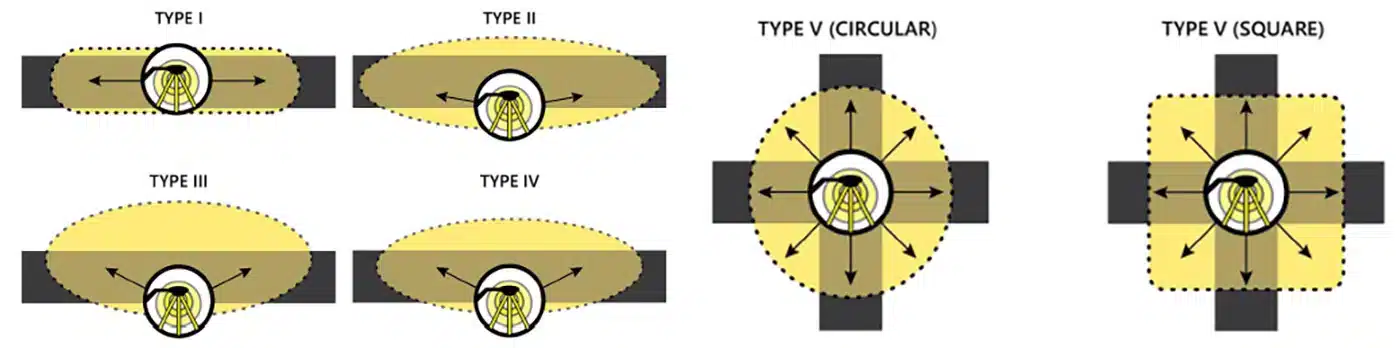
Optical lenses must support modular designs for flexible replacement while offering professional asymmetric road lighting distributions like Type II and Type III alongside narrow, medium, and wide beam angles to ensure precise light coverage and prevent light pollution. For a deeper breakdown of photometric files, you can refer to our guide on understanding LED light beam angles.
System Efficacy and LM-79 Verification

Standard luminaire efficacy targets must reach at least 150 lm/W while premium solutions demand 170 lm/W or higher. This figure must reflect the actual luminaire efficacy after factoring in driver and optical losses rather than relying on theoretical chip efficacy, and it must be backed by an official LM-79 report.
Color Parameters and Photobiological Safety

Tenders specify exact correlated color temperatures for road classes like 3000K warm white or 4000K neutral white and require tight tolerances within plus or minus 200K to ensure uniform color tones across entire roadways. Road lighting typically requires a color rendering index of 70 or higher while premium commercial zones may demand 80 or higher to guarantee great color recognition at night. To learn more about how color parameters impact engineering acceptance, check our detailed article on Correlated Color Temperature Kelvin / K Value in LED Lighting.
To prevent visible patchy discrepancies when multiple lights are installed side-by-side, top-tier tenders require strict MacAdam ellipse steps such as SDCM under 5 or SDCM under 3. Furthermore, fixtures must comply with photobiological safety standards like IEC/EN 62471 to achieve low risk or risk-free blue-light ratings backed by formal lab reports. For insights into optical safety and radiation metrics, review our discussion on Visible Light Wavelength and Spectral Power Distribution of LED Lights.
Lifetime Expectancy and Lumen Maintenance
Lifetime metrics cannot merely state chip lifespans and must instead guarantee a luminaire-level life of L90B10 reaching at least 100,000 hours. This must be supported by complete LM-80 and TM-21 reports along with thermal equilibrium data under real operating currents to meet the stringent durability demands of any global Street Light Tender.
Electrical Characteristics and Driver Specifications
Fixtures require wide input voltage compatibility spanning 85 to 280VAC or at least 220 to 240VAC alongside a full-load power factor of 0.95 or higher and a total harmonic distortion under 10 percent. Drivers must be isolated from the LED PCB and independently replaceable while typically designated to tier-one brands.
Electrical requirements often dictate the inclusion of dimming protocols to support energy-saving schedules and adaptive municipal lighting strategies. For a comprehensive breakdown of driver configurations, read our detailed article on The Ultimate Guide to Street Lights with 0-10V Dimming.
Surge and Lightning Protection
Internal differential and common mode surge protection must be integrated within the driver. Furthermore, fixtures must feature an independent and detachable external surge protection device targeting ratings of at least 12 kV and 10 kA in compliance with IEC standards.
International Safety and Certifications
European and high-end markets usually mandate certifications like ENEC, ENEC+, CB, CE, LVD, EMC, and RoHS. Producers must also hold ISO system certifications for quality, environmental management, occupational health, and energy management alongside Zhaga Consortium membership.
Warranty and Traceability
Tenders require a standard warranty of at least 5 years and up to 10 years for premium projects. Every single luminaire must feature a unique serial number or barcode to ensure complete traceability from the production batch and driver down to individual LED modules.
LED Street Light Tender Matrix (Quick Reference)
To help project managers and procurement heads cross-reference requirements as part of a complete street light tender document checklist, here is a consolidated parameter matrix:
| Tender Parameter Dimension | Standard Tender Requirement / Target Parameter | ZGSM Technical Support & Factory Advantage |
| Wattage Range | 50W to 200W modular configurations | Covers mainstream municipal tiers from 50W up to 200W |
| Housing & Protection | High-pressure die-cast aluminum with low copper, IP66, IK10 | Features anti-UV powder coating tailored for coastal high-humidity and heavy industrial environments |
| Luminaire Efficacy | Standard ≥ 150 lm/W; Premium ≥ 170 lm/W | Utilizes high-efficacy SMD 5050 LEDs with tightly controlled driver and optical losses |
| CCT & CRI | 3000K / 4000K / 6500K, CRI ≥ 80 | 4000K as core certified CCT with tolerances strictly held within ± 200K |
| Lifetime & Decay | L90B10 ≥ 100,000 hours | Backed by LM-80/TM-21 reports and NTC intelligent thermal derating protection mechanisms |
| Surge Protection | PF ≥ 0.95, THD < 10%, External SPD ≥ 12 kV | Fully compliant with IEC standards for lightning-prone zones |
| Smart Interfaces | None / NEMA 7-pin / Zhaga Book 18 | Modular socket options for effortless local smart node integration overseas |
| International Certs | ENEC, CB, CE, RoHS, ISO systems | Comprehensive test reports available, supporting OEM joint branding and certificate extensions |
Summary
Winning a competitive Street Light Tender or decoding an LED street light tender specification doesn't have to be overwhelming when you break it down into these core technical parameters. By verifying everything from LM-79 efficacy reports and IP/IK housing ratings to surge protection and smart controller interfaces, you can confidently steer clear of hidden compliance traps. Explore our full range of certified outdoor luminaires on the ZGSM Street Lighting Products Page or contact our engineering team directly for bespoke project support.
Related Products


Related Blogs


Related Cases


People also ask
Author introduction

Hello Customers,
My name is Taylor Gong, I’m the product manager of ZGSM Tech. I have been in the LED lights industry for more than 13 years. Good at lighting design, street light system configuration, and bidding technology support. Feel free to contact us. I’m happy to provide you with the best service and products.
Email: [email protected] | WhatsApp: +8615068758483