
Frequently asked questions about street light LED driver which maters its price
Frequently asked questions about street light LED driver which maters its price
Introduction
Currently, the prices of LED drivers specifically designed for streetlights vary widely on the market, with price differences ranging from budget models to high-end custom models reaching several times the cost. Outdoor streetlights are constantly exposed to extreme temperature fluctuations, lightning surges, humidity, dust, and other challenging environmental conditions. Their stability and durability directly determine the total life-cycle cost of the entire luminaire. As the “heart” of a streetlight, the pricing of a street light LED driver is by no means determined solely by the brand, but rather by a combination of factors such as efficiency (About luminous efficacy), protection rating, dimming flexibility, and smart interaction capabilities. Generally speaking, the higher the power supply’s efficiency, the higher its protection rating, the more comprehensive its protective features, and the richer its dimming capabilities, the higher the price will be. Additionally, whether the power supply is isolated or non-isolated, the type of dimming method used, and the presence or absence of auxiliary power sources are also key factors influencing price. A thorough understanding of these price-determining factors can help purchasers avoid the trap of “winning the bid with a low price but facing high maintenance costs,” and strike the optimal balance between initial costs and long-term quality.
Different specifications of street light LED driver
Different functional configurations are the key factor driving price differences in street light LED drivers. Basic models retain only the core function of constant-current output; with a simple circuit design, they merely meet the requirement of “powering on” and are sold at a lower price. The currently popular 0–10V (1–10V) dimmable power supplies, on the other hand, require the addition of dimming circuits, which correspondingly increases their price. Mid- to high-end products designed for municipal thoroughfares and smart lighting applications (such as the IT DEXAL series) integrate advanced features such as AstroDIM timer dimming, contant lumen output (What’s light decay and function of CLO?), end-of-life alerts, and DALI-2 communication. Each additional feature requires extra control chips, sensors, and rigorous hardware and software integration testing, all of which further drive up the power supply’s price. More specifically, power supplies are categorized as isolated or non-isolated, Class I or Class II, and may incorporate different protection features, dimming methods (0-10V vs. DALI), and other auxiliary functions. All of these factors influence the price to varying degrees; therefore, we will first focus on explaining these differences before analyzing street light LED driver pricing.

Isolated or non-isolated street light LED driver
There are two main types of LED drivers: isolated and non-isolated. As the name suggests, non-isolated drivers lack a safety isolation barrier (i.e., electrical isolation) between their input and output. This design is relatively simple and requires fewer components, resulting in ultra-high efficiency, reduced heat generation, and a compact form factor; generally, they are also much less expensive. In isolated street light LED drivers, there is no direct electrical connection between the input and output circuits (i.e., electrical isolation is present), and the path between the input and output is in a high-impedance, insulated state. Isolated and non-isolated (More about isolated and non-isolated LED driver) architectures are the fundamental indicators that distinguish LED driver cost and safety compliance levels. Precisely because non-isolated drivers feature simple circuitry, fewer components, and a small form factor, their cost is lower; however, their disadvantage is lower safety. Due to their relatively lower safety, these drivers are mostly used in luminaires that are inaccessible to users (such as ceiling-mounted downlights, floodlights, and high-bay lights). In contrast, isolated street light LED drivers achieve complete electrical isolation between the input and output, effectively preventing leakage current and high-voltage surges. Such power supplies (such as the Inventronics IT 0-10 P67 series), due to their isolated design, offer relatively higher safety, effectively preventing safety incidents such as electric shock. At the same time, the isolated design effectively protects sensitive components (such as 1(0)-10V dimming circuits) from the effects of high voltage at the input. Electrical isolation requires the addition of transformers and high-voltage insulation components, which significantly increases material costs and manufacturing complexity; consequently, the cost is naturally much higher than that of non-isolated designs. Isolated designs are often the preferred solution for municipal street lighting, high-mast lighting, and other area lighting applications. Of course, for price-sensitive projects where products are designed and maintained by professionals, non-isolated street light LED drivers also have a market due to their cost-effectiveness.
Class I or Class II street light LED driver
A driver’s ability to power Class I or Class II luminaires stems directly from different safety design standards, which in turn affect cost and pricing. Drivers compatible with Class I luminaires rely on reliable grounding as the primary means of protection, with insulation meeting conventional standards, and are priced at a moderate level. In contrast, street light LED drivers compatible with Class II luminaires (such as specific models in the IT 0-10 P67 series) do not require grounding and instead rely on double insulation or reinforced insulation to prevent the risk of electric shock. This places extremely high demands on insulation materials, enclosure design, and internal creepage distances. A power supply that is compatible with both Class I and Class II luminaires (i.e., “one power supply for two luminaire classes”) helps customers streamline their SKUs. This compatible design requires a more complex insulation layout and more rigorous withstand voltage testing; as a result, its R&D and quality control costs are higher than those of single-class products, and the market price is naturally higher as well. Common street light LED drivers, such as the IT 0-10 xxx/100-277 P67 E, EUM-xxxSxxxDE, and IT DX xxx/220-240/xxx NFC E, are suitable for both Class I and Class II applications. Other street light power supplies, such as the IT 0-10 xxx/100-277 P67 G and EUM-xxxSxxxDG, are only suitable for Class I applications, and their costs are correspondingly lower. Compared to the distinction between isolated and non-isolated designs, the difference between Class I and Class II has a much smaller impact on the price of LED drivers and also the street light price (Main factors affecting street light prices).
Dimming options of street light LED driver
Differences in dimming solutions directly reflect technical complexity and material costs. The basic model without dimming functionality has the simplest structure and the lowest price. Conventional 0-10V, PWM, and resistive dimming require the addition of dedicated signal processing circuits, which increases both costs and price. The isolated 0-10V feature provided by the IT 0-10V P67 series not only supports configurable positive and negative logic (compatible with tunnel negative logic control systems) but also offers a variety of dimming curves to choose from (0-5V, 1-5V, 1-10V, etc.), allowing for customization of dimming-to-off and non-dimmable modes. Additionally, this power supply supports AstroDIM timer based dimming, which outperforms traditional five-step time controls. This series also supports dimming priority mode, allowing it to prioritize responses to external signals. For example, in previous years, many streetlights were equipped with built-in timer dimming and NEMA sockets (What’s NEMA socket?). In such cases, if a smart controller is installed later, conventional power supplies would require reprogramming the street light LED driver to accept external signals. However, the IT 0-10V series does not require reprogramming; it can accept standard 0–10V signals and automatically reverts to the original AstroDIM mode when the external signal disappears. This design aligns well with user habits and facilitates upgrades to smart control systems. This highly flexible smart dimming solution features a tight integration of hardware and software and requires significant R&D investment; consequently, its price is certainly higher than that of traditional 1-10V or 0-10V dimming power supplies. In addition to these dimming methods, DALI dimming is also commonly used in municipal road lighting today, and its price is often higher than that of 0-10V street light LED drivers.

D4i of street light LED driver
In the previous section, we mentioned DALI dimming. However, with technological advancements and changing demands, street lights with DALI dimming are no longer limited to simple dimming—the D4i standard has since emerged. The D4i standard (What’s street light with D4i?), introduced in recent years, is an international standard for smart outdoor lighting. Drivers compliant with this standard include the Inventronics IT DEXAL series, the Philips SR series, and the Inventronics EBS BT2 series, among others. These are priced higher than standard DALI dimming power supplies and are significantly more expensive than ordinary products. You can think of D4i as an extension of DALI; in addition to enabling dimming control of luminaires, it places greater emphasis on intelligent communication and control among the luminaire’s internal components (such as street light LED drivers and sensors). The D4i standard supports the collection and analysis of data on lighting assets, energy consumption, and diagnostics—features not available in DALI-2. The D4i standard establishes strict, unified specifications for driver mechanical dimensions, interfaces, electrical parameters, DALI-2 communication, auxiliary power supply, and interchangeability. This ensures compatibility among luminaires and sensors (Street light with sensor) produced by different manufacturers, meaning sensors and communication modules can be easily integrated into LED luminaires without the need for additional wiring. Although standardized design and rigorous certification increase costs, the standard’s robust versatility, interchangeability, and plug-and-play smart node capabilities make it a long-term choice for large-scale municipal projects.
Other functions of street light LED driver
The auxiliary power supply is a key indicator that distinguishes traditional drivers from drivers specifically designed for smart streetlights, and it is also a major factor contributing to price differences between products. Ordinary drivers merely supply power to the LED light source, featuring simple circuitry and low cost; smart streetlights, however, require the integration of sensors, cameras, communication modules, and other devices into street light LED drivers. This necessitates that the driver be equipped with an independent auxiliary power output; otherwise, additional equipment would need to be installed, along with complex wiring. Different product series offer auxiliary power specifications such as 12V/100mA and 24V/125mA. The 12V auxiliary power source can power microwave sensors, while the 24V auxiliary power source is compatible with smart streetlight modules that use Zhaga interfaces (Zhaga vs NEMA). These products require additional design for voltage regulation, current sharing, and protection circuits, which increases component and debugging costs, resulting in a significantly higher price than standard products. The outdoor power grid environment is complex, and the protection features of the driver also determine the product’s grade and pricing. Mainstream protection functions include overvoltage, overcurrent, short-circuit, surge, NTC, and ESD (electrostatic discharge) protection. Taking surge protection as an example, IT series products are equipped with dual lightning protection: 6 kV differential-mode and 10 kV common-mode surge protection (What’s SPD?). In addition, some street light LED drivers are equipped with a light decay compensation feature, which further optimizes product performance, ensuring the long-term stable operation of outdoor streetlights while achieving energy savings. When encountering output instability or component degradation, learn how to fix flickering LED lights caused by driver failures by testing and replacing faulty components. All of the above features contribute to the higher overall price of street light LED drivers.

Price reference of street light LED driver
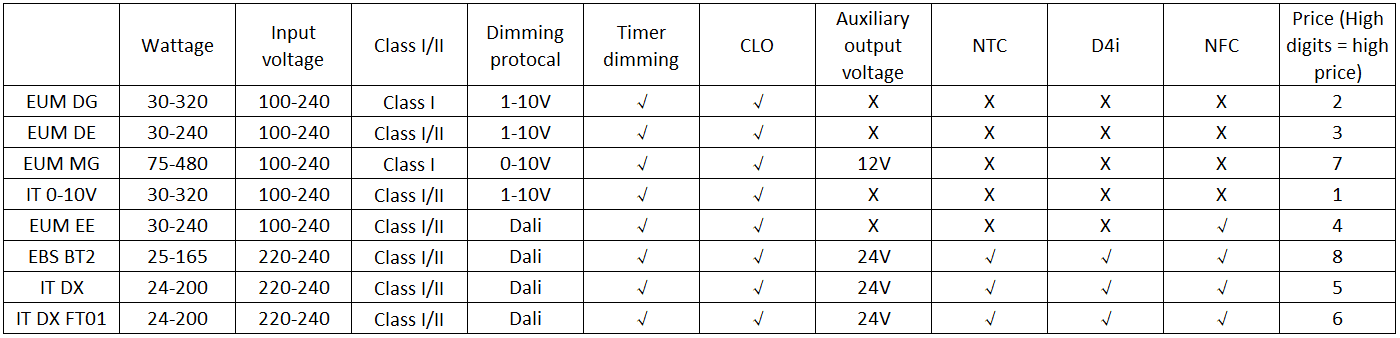
As shown in the table, the IT 0-10V series power supplies are the most affordable and offer a relatively comprehensive set of features. The EUM DG, EUM DE, EUM EE, EUM MG, and EBS-BT2 were all launched during the same period and hit the market earlier than the IT 0-10V series; consequently, they are priced higher and are currently being gradually replaced by the IT 0-10V series. A comparison of these products clearly shows that Class II models are priced higher than standard Class I models; models with auxiliary power supplies are priced higher than the EUM DG and EUM DE models without auxiliary power supplies; the EUM EE, which supports DALI dimming, is priced higher than the previous three; and the EBS series power supplies, which meet the D4i standard, are the most expensive. The IT series is divided into two major categories: IT 0-10V and IT DX. The IT 0-10V series consists of 0-10V dimming models, including both Class I and Class II specifications, which are priced the same; The IT DX series consists of DALI-dimmable power supplies that are compatible with the D4i standard and equipped with a 24V auxiliary power supply, of which the price is much higher than IT DX series. It is important to note that not all models in this series feature NTC functionality (which comes standard across the entire EBS series). If a project requires NTC functionality (What’s NTC and its function?), you must confirm availability and request a quote directly from the power supply manufacturer.
ZGSM street lighting solutions
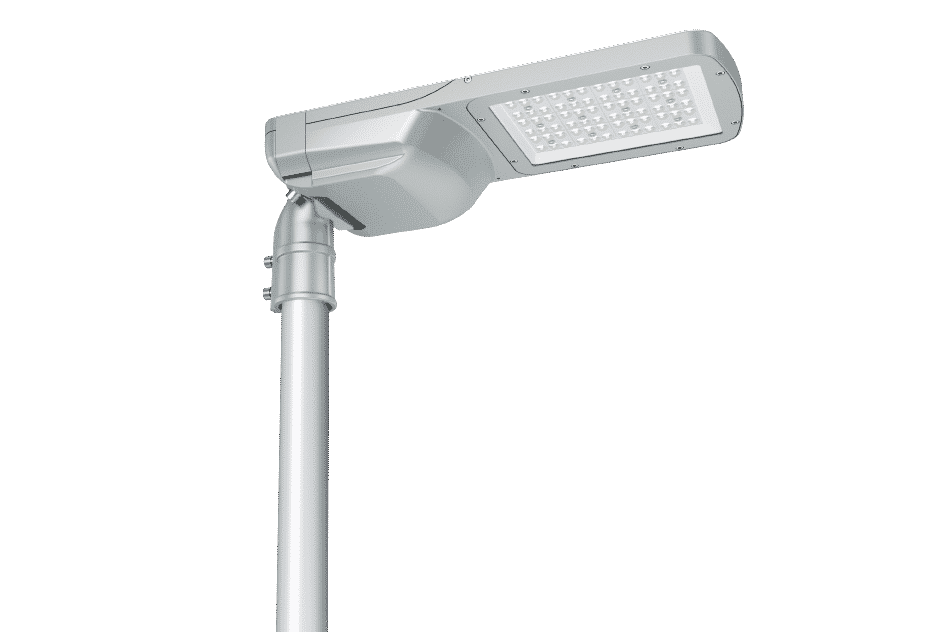
ZGSM’s street lights are compatible with all the above-mentioned street light LED drivers, allowing for flexible adaptation to different project requirements. Whether your priority is cost, safety, or functionality, ZGSM can help you find the right solution. As the street light LED drivers are upgraded by the manufacturers, our street light products will be updated accordingly. Currently, we are in the process of applying for certificates for street lights with IT 0-10V and IT DX, including ENEC, CE, CB, and ENEC+ (About ZGSM ENEC+ street lights). We are confident that we will obtain these certificates soon, which will further enhance the competitiveness of our products. Below are the ZGSM ST17, ST18, ST19, ST20, and ST23 series street lights. Click on the corresponding images for more information.


Summary
This article systematically analyzes the key factors contributing to price variations in street light LED drivers. The article points out that, as the “heart” of a streetlight, the price of a street light LED driver is determined by a combination of factors, including efficiency, protection rating, dimming flexibility, and smart interaction capabilities. First, isolated and non-isolated designs directly impact safety and cost; isolated power supplies, which use transformers and high-voltage insulation components, are significantly more expensive than non-isolated products. Second, while differences between Class I and Class II insulation ratings have a relatively minor impact on price, Class II-compatible drivers incur higher costs due to the requirement for a double-insulation structure. Regarding dimming functions, basic models without dimming functionality are the least expensive; dimming solutions such as 0–10V (0-10V dimming and its application in street lights) and DALI become progressively more complex as their technical sophistication increases; and smart drivers compliant with the D4i standard command the highest prices due to their integration of data communication, auxiliary power supply, and strict interchangeability specifications. Furthermore, additional features such as auxiliary power supplies, surge protection, and lumen maintenance compensation further drive up product prices. This article helps procurement professionals understand how different combinations of features affect the balance between initial costs and long-term O&M expenses of street light LED drivers, thereby avoiding the trap of “low-cost bidding but high O&M costs.”
Related Products


Related Blogs


Related Cases


People also ask
Author introduction

Hello Customers,
My name is Taylor Gong, I’m the product manager of ZGSM Tech. I have been in the LED lights industry for more than 13 years. Good at lighting design, street light system configuration, and bidding technology support. Feel free to contact us. I’m happy to provide you with the best service and products.
Email: [email protected] | WhatsApp: +8615068758483